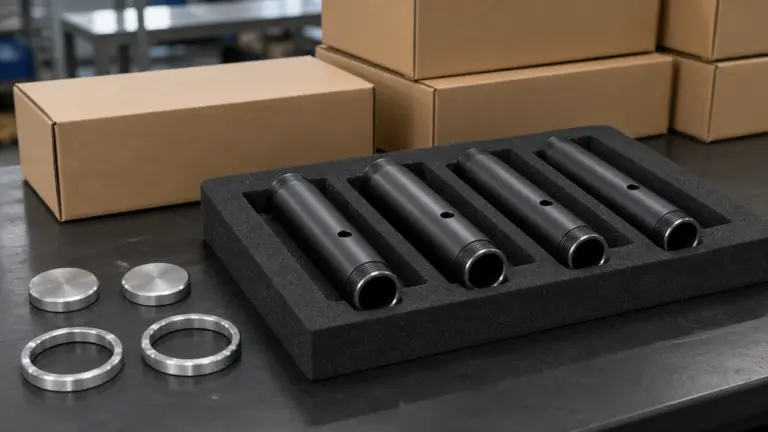
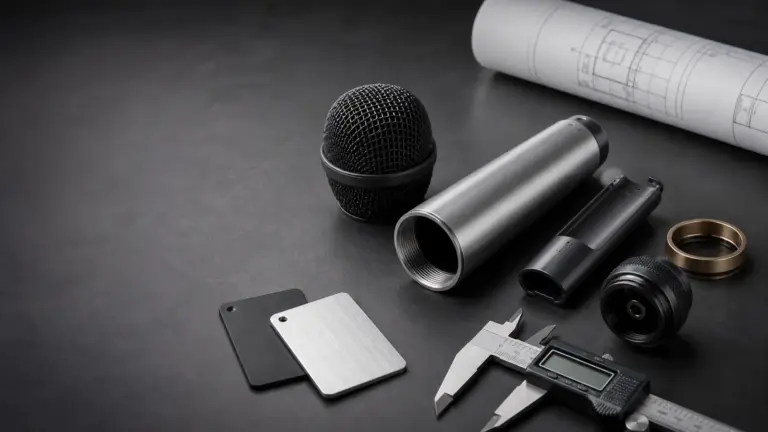
Top-tier condenser microphone housing use heavy brass tubing primarily because of its physical properties, not brand tradition or cost considerations. Brass’s high density and internal damping effectively isolate external vibrations and prevent cavity resonance, thereby protecting the signal captured by the condenser diaphragm from interference. This is an engineering advantage that aluminum alloys or zinc alloys find difficult to replicate.
Material Physical Properties: Why Brass Stands Out
A condenser microphone diaphragm is extremely sensitive and can respond to sound pressure changes as low as 0.001 Pa. Any mechanical resonance from the housing can be superimposed onto the signal, causing unpredictable peaks and dips in the frequency response curve. Therefore, choosing a housing material is not merely a structural issue—it is fundamentally an acoustic issue.
Core Parameter Comparison of Three Common Housing Materials
| Material | Density (g/cm³) | Rockwell Hardness (HRB) | Relative Damping Coefficient | Electroplating Adhesion | Machinability Index |
|---|---|---|---|---|---|
| C36000 Free-Cutting Brass | 8.49–8.53 | 55–65 | High | Excellent | 100 (baseline) |
| 6061 Aluminum Alloy | 2.70 | 60 | Low | Good | ~50 |
| Zamak 3 Zinc Alloy | 6.60 | 82 | Medium | Fair | ~30 |
| 304 Stainless Steel | 7.93 | 70-80 | Medium | Poor (requires treatment) | ~45 |
Data Sources:
- Copper Development Association,C36000 Free-Cutting Brass https://www.copper.org/applications/rodbar/alloy360/corrosion_tests.php
- KDM Fabrication《黄铜密度详细解析》https://kdmfab.com/zh/黄铜密度/
Four Core Advantages of Brass Tubing
1. High density provides structural mass, and mass suppresses vibration transmission
Brass has a density about three times that of aluminum. Greater mass means external vibrations (such as stage floor vibrations and low-frequency noise caused by handheld operation) are significantly attenuated before they reach the diaphragm. This works in a complementary way with a shock mount: the shock mount handles low-frequency mechanical noise, while the brass tube itself addresses mid- to high-frequency structural resonance.
Research published by the MIT Acoustics Laboratory also points out that microphone housing vibration isolation is directly related to the acoustic impedance of the housing material. High-density materials show clear advantages in blocking structure-borne sound. (Source: JASA, 1986)
2. Internal damping properties suppress the housing’s own resonance
The internal damping coefficient of aluminum alloys is much lower than that of brass. In engineering materials, internal damping determines how quickly a material’s self-vibration decays after excitation. When impacted, aluminum alloys retain vibrational energy for a longer time, whereas brass converts that energy into heat more quickly.
This characteristic has been thoroughly validated in instrument manufacturing—brass is used for saxophones, trumpets, and other brass instruments precisely because it has irreplaceable damping properties that help maintain tonal stability.
3. Extremely high dimensional precision and consistency
The air gap between a condenser microphone diaphragm and backplate is typically controlled within 20–50 μm, which imposes extremely high requirements on the inner-bore dimensional accuracy of the housing tube. C36000 free-cutting brass has a machinability rating of 100 (industry benchmark). By comparison:
- Aluminum alloys are around 50
- Stainless steel is around 45
- Zinc alloy die-cast parts are difficult to achieve equivalent inner-bore precision
Brass can achieve a surface finish below Ra 0.4 μm with relatively low tool wear, ensuring highly consistent internal cavity dimensions across every microphone tube.
4. Excellent electroplating adhesion ensures long-term appearance stability
Professional-grade microphones usually require surface finishes such as nickel, matte black, or gold plating. After standard cleaning procedures, brass provides far better plating adhesion than aluminum alloys (which require special pre-anodizing treatment) and zinc die-cast parts (which are prone to porosity that can cause blistering of the plating).
Under long-term use in high-humidity environments (such as live performance venues), the coating integrity of brass housings is clearly superior to that of other materials. This is also one reason many brand OEMs remain confident in their product warranty policies.
Which top brands use heavy brass housings?
The following widely cited industry examples show that brass housings are not a niche choice:
- Neumann U87 Ai: The housing is precision-machined from brass and finished in matte black or nickel plating, making it a de facto standard in professional studios. The microphone’s net weight is about 500 g, with housing density as a major contributor to that weight.
- AKG C414 series: Uses a brass housing combined with zinc-alloy side panels to balance structural strength and acoustic requirements.
- Large OEM product lines: In major microphone OEM factories in China and Europe, brass housings account for more than 70% of professional condenser microphones (industry estimate), while aluminum-alloy housings are mainly used in dynamic microphones or low-cost entry-level condenser products.
Practical Manufacturing Challenges of Brass Housings
Using brass is not without trade-offs, which is why some brands still choose compromises:
- Weight: A total microphone weight of 400–600 g can be limiting for certain handheld use cases, which is also why thick-wall brass is less common in stage vocal microphones.
- Cost: Raw brass material costs about 2–3 times that of aluminum alloys, and machining time is relatively higher.
- Machining temperature control: During long-stroke turning, strict cooling control is required to prevent thermal expansion from affecting inner-bore precision.
For microphone assembly factories and brands, this means supplier machining capability is critical. Keeping wall-thickness tolerance within ±0.03 mm and inner-bore roundness within 0.01 mm are key indicators that distinguish professional-grade housings from ordinary ones.
When can alternative materials be considered?
Not every application requires heavy brass. Here is a simple material-selection reference framework:
| Application | Recommended Material | Reason |
|---|---|---|
| Studio professional condenser microphone | Heavy-wall brass (wall thickness ≥ 3mm) | Optimal acoustic vibration isolation, stable plating |
| Live performance vocal microphone | Aluminum alloy or thin-wall brass | Lightweight priority, vibration requirements secondary |
| Entry-level / consumer products | Zinc alloy die casting | Cost priority, high efficiency for mass manufacturing |
| ASMR / close-range recording microphone | Heavy-wall brass | Low self-noise, high vibration isolation requirements |
| Outdoor / broadcast news reporting | Anodized aluminum alloy | Lightweight and durable, plating adhesion acceptable after anodizing treatment |
Our Observations
Based on our 20 years of experience supplying housings to global microphone brands and assembly factories, customers who choose brass housings show clearly better long-term reorder rates and brand-upgrade cycles than those using alternative materials. This is not because brass is more expensive, but because end users can feel the difference in products made with brass—its in-hand weight, the damped feel when pressing the switch, and whether the coating remains intact after two to three years.
These aspects of perceived quality ultimately translate into brand premium.
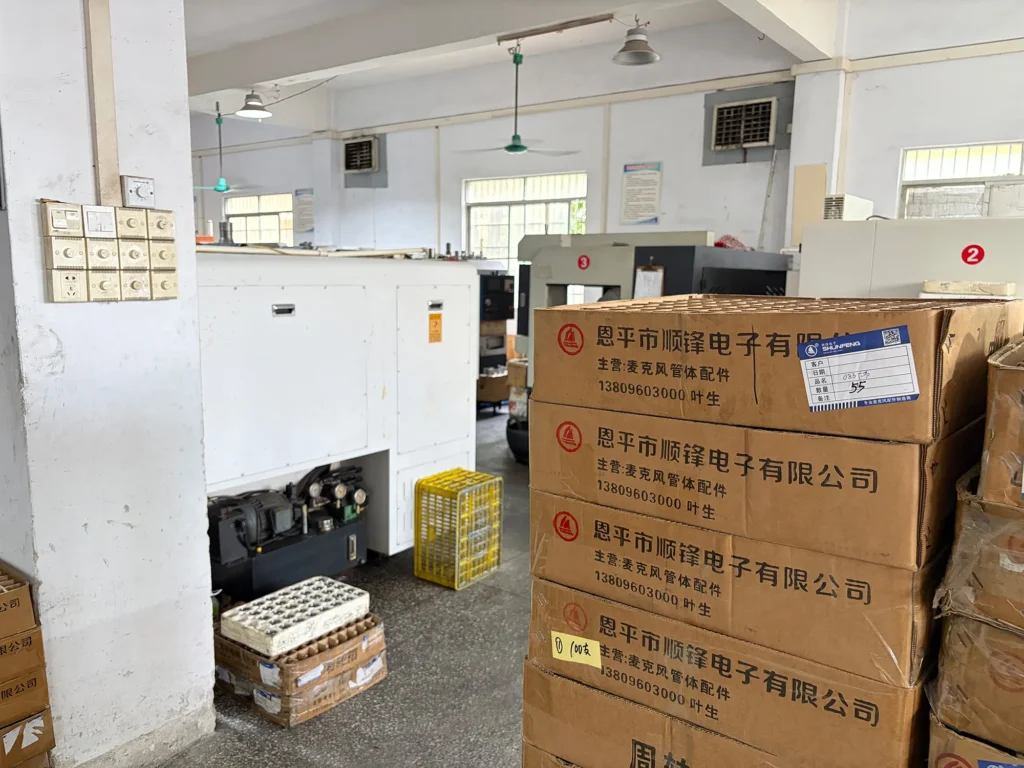
About ENPING SHUNFENG ELECTRONICS CO., LTD
We are a professional microphone housing manufacturer based in Enping, Guangdong, with over 20 years of expertise in precision turning and electroplating processes. We specialize in supplying brass and aluminum-alloy condenser microphone tubes to microphone assembly factories and brand owners worldwide. To learn more about our standard tube specifications or custom machining capabilities, feel free to contact us to request free samples.