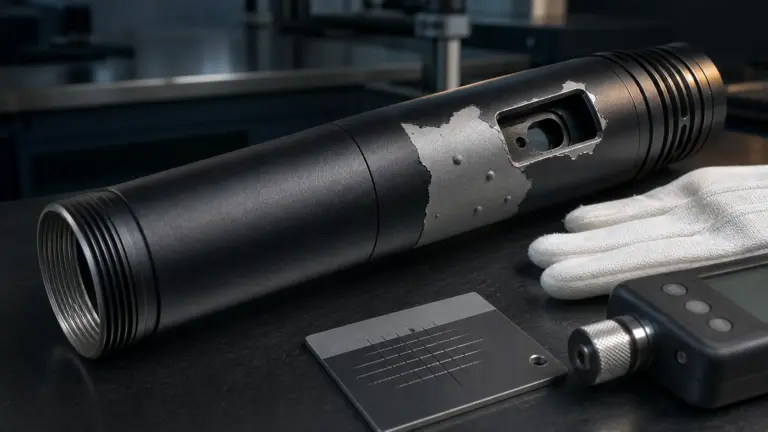
A suitable microphone housing supplier for Vietnam is not simply the factory offering the lowest tube price. The supplier must produce parts that fit the capsule, PCB, battery compartment, switches, grille, end cap, and assembly fixtures used at your Vietnamese plant—and must pack and document those parts so they arrive ready for controlled incoming inspection.
For a new sourcing program, the safest sequence is straightforward: define the component boundary, verify the factory, approve physical samples on the actual assembly line, align outgoing and incoming QC, and only then finalize the commercial and logistics handoff. This guide explains how to run that process for standard or custom microphone housings sourced from China.
A Practical China-to-Vietnam Sourcing Sequence
| Stage | Buyer decision | Evidence to collect | Risk if skipped |
|---|---|---|---|
| Requirement definition | What parts, interfaces, materials, and finishes are included? | Controlled BOM, 2D/3D files, mating-part data, cosmetic standard | Quotes and samples are not comparable |
| Supplier verification | Can the supplier control the required processes? | Factory evidence, process route, tooling scope, inspection examples | Outsourcing and variation remain hidden |
| Sample approval | Does the housing work in the finished assembly? | Dimensional report, approved sample, trial-assembly record | A visually good part may stop the line |
| Quality alignment | Will supplier OQC match Vietnam IQC? | CTQ list, defect limits, sampling plan, report format | Repeated disputes and inconsistent rejection |
| Logistics definition | Who handles each cost, risk, document, and handoff? | Named Incoterm, packing spec, shipment data, broker review | Delays and unexpected landed costs |
| Repeat-order control | How are revisions and nonconformities managed? | Revision log, approved master sample, corrective-action process | Old versions or recurring defects reach production |
1. Define What the “Microphone Housing” Includes
Two suppliers may quote a microphone housing while offering very different scopes. One quote may cover only a body tube. Another may include the grille head, end cap, battery compartment, decorative rings, switch parts, internal holders, or fasteners. Compare like with like before comparing unit prices.
Start with a controlled bill of materials that states, for each item:
- Part name and revision
- Quantity per finished microphone
- Material and manufacturing route
- Surface finish, color, texture, and logo method
- Critical dimensions and inspection datums
- Mating component or interface
- Packaging quantity and orientation
- Whether the part is supplied by the housing factory, the Vietnam assembler, or another vendor
For a custom design, provide both 3D geometry and a 2D drawing. The 3D model helps the supplier understand form and assembly space; the 2D drawing should control tolerances, materials, finishes, datums, and acceptance criteria. If drawings are incomplete, a physical reference sample can help communicate the desired structure, but it should not silently replace measurable requirements.
Freeze the interfaces that can stop the Vietnam line
The most important dimensions are rarely the most visible ones. Identify the features that affect the capsule seat, PCB location, battery contact compression, button travel, display alignment, connector opening, thread engagement, grille fit, end-cap fit, and assembly-fixture location.
Also confirm whether acceptance applies before or after surface finishing. Paint, plating, or anodizing can change fits at threads, bores, and mating faces. A nominally correct unfinished part may become tight after finishing if the drawing and inspection plan do not account for the coating system.
2. Shortlist a China Supplier with Manufacturing Evidence
A polished catalogue shows what a supplier wants to sell. A sourcing decision requires evidence of how the required part will actually be made and controlled.
Ask each candidate to explain the proposed route from raw material to packed part. For a metal microphone housing, that route may involve tooling, die casting or tube forming, CNC machining, deburring, polishing or blasting, surface finishing, logo application, inspection, and protective packing. Not every step has to be in-house, but the supplier should disclose important subcontracted processes and explain how specifications and quality records flow across them.
Use the following questions during a remote or on-site factory review:
| Buyer question | Useful evidence | Why it matters |
|---|---|---|
| Who controls the production tooling and fixtures? | Tool list, maintenance record, fixture photos, ownership terms | Tool condition and access affect consistency and future changes |
| Which processes are performed internally? | Process flow, equipment list, live production view | Reveals handoffs and subcontracting risk |
| How are materials and revisions identified? | Material record, traveler, drawing revision on work order | Reduces mix-ups between variants |
| Which features are inspected in process? | Control plan, measurement method, sample report | Shows whether critical dimensions are managed before final inspection |
| How are cosmetic defects judged? | Approved master or limit samples, lighting and viewing rules | Replaces subjective arguments with shared criteria |
| How are nonconforming parts contained? | Segregation method, disposition record, corrective-action example | Tests whether problems are controlled rather than hidden |
Do not treat a generic certification, a marketplace badge, or a business licence as proof that a factory can hold your microphone-specific interfaces. Those documents may support legal or system checks, but capability still has to be demonstrated on the proposed material, process, finish, and part geometry.
For a broader screening checklist, review the warning signs when choosing a microphone component supplier.
3. Choose the Right Sample Stage
“Send a sample” can mean four different things. Define the purpose before paying for or approving it.
| Sample type | What it can prove | What it cannot prove |
|---|---|---|
| Existing-model sample | General construction, finish range, supplier workmanship, rough compatibility | Your custom geometry or production tool stability |
| Prototype | Structure, grip, internal space, interference, early assembly sequence | Final die-cast behavior, final finish, or mass-production consistency |
| First article or tool-trial sample | Tooled geometry, key dimensions, initial finish and fit | Long-run process stability by itself |
| Pilot lot | Assembly yield, packing, inspection flow, line handling, early process variation | Performance across every future batch without ongoing control |
The approval record should identify the sample type, drawing revision, material, finish, date, quantity, deviations, and approval status. If a deviation is temporarily accepted, record whether it applies only to the sample, the pilot lot, or future production. Never let a verbal concession become the new specification by accident.
Before committing to custom tooling, use the microphone housing tooling checklist to review structure, material, tolerances, assembly, and cosmetic acceptance.
4. Approve the Housing on the Actual Vietnam Assembly Line
Supplier measurements are necessary, but the final approval should include a complete trial assembly at the Vietnamese plant. The housing interacts with parts and processes the China supplier may not control.
The trial should answer practical line questions:
- Can the PCB, capsule, battery contacts, switches, display, connectors, and wiring be installed without force or improvised rework?
- Do tools have enough access, and can operators follow the intended sequence?
- Do threads start smoothly and reach the correct final position?
- Are gaps, steps, color differences, and logo orientation acceptable after full assembly?
- Does the part fit the plant's fixtures, gauges, trays, and packaging flow?
- Does assembly time remain stable across multiple samples and operators?
- Are acoustic, RF, grounding, drop, and other finished-product requirements still met after the new housing is installed?
The housing factory should not be asked to guarantee the performance of a complete microphone it has not been given enough information to evaluate. Share relevant mating parts, interface drawings, and test expectations, then separate part-level acceptance from finished-product validation.
Create a signed approval package containing the accepted physical sample or master sample, the controlled drawing set, measurement results, finish reference, deviation list, and photographs of the approved assembly. That package becomes the common reference for the China supplier, Vietnam engineering team, and Vietnam IQC team.
5. Connect Supplier OQC with Vietnam IQC
Quality control works best when the supplier's outgoing inspection and the assembly plant's incoming inspection use the same definitions. If one team measures the coated part from one datum while the other measures an unfinished reference from another datum, both may believe they are correct.
Build one critical-to-quality list covering at least these areas:
| Control area | Possible checks | Buyer decision required |
|---|---|---|
| Identity | Part number, revision, color, lot, quantity | How will variants and lots be labelled? |
| Dimensions | Threads, capsule seat, bores, opening positions, overall straightness | Which datums, tools, and conditions apply? |
| Assembly | Go/no-go gauges, mating parts, torque or insertion checks | Which interfaces require functional verification? |
| Cosmetics | Scratches, dents, particles, exposed base metal, color and gloss | What are the viewing conditions and defect limits? |
| Finish and marking | Adhesion or wear checks, logo position and clarity | Which test method and acceptance level apply? |
| Packaging | Separation, thread protection, tray orientation, carton integrity | What damage modes must the pack prevent? |
Acceptance sampling can reduce inspection effort, but “AQL inspection” is not a complete specification. The current ISO 2859-1:2026 defines AQL-indexed sampling schemes for lot-by-lot inspection. The purchase agreement still needs to state the standard edition, lot definition, inspection level, sample plan, defect classes, AQL values, and switching rules. Critical functional or safety-related characteristics may require different controls from routine cosmetic sampling.
For the first production lots, consider tighter incoming checks and a larger assembly trial until the process is stable. Then use actual defect and line-yield data to adjust inspection effort. Send rejected samples, photographs, measurements, lot details, and the exact specification clause back to the supplier; “the parts do not work” is not enough information for a useful corrective action.
6. Plan Packaging, Incoterms, and China-to-Vietnam Logistics
The best logistics plan is not automatically the fastest quotation. It is the plan that protects parts, makes responsibilities explicit, supports customs clearance, and replenishes the assembly line without excessive inventory.
Specify packaging around the real failure modes
Finished metal housings can be damaged when parts rub together, heavy grilles move inside a carton, threads contact hard surfaces, or trapped moisture affects the finish. Define individual separation, trays or sleeves, thread protection, pack quantity, carton weight, orientation, moisture controls when required, and any returnable-packaging constraints at the Vietnam plant.
Ask for packed-carton dimensions and gross/net weight before choosing a transport quotation. Freight comparisons based only on unit price miss volumetric weight, consolidation fees, handling charges, and the cost of damaged parts.
Name the commercial handoff precisely
Incoterms® rules allocate defined delivery costs, risks, transport obligations, and customs responsibilities between buyer and seller. The ICC Incoterms® 2020 rules include 11 trade terms. Put the selected rule, the named place or port, and “Incoterms® 2020” in the quotation and purchase order rather than using a three-letter term alone.
Confirm separately:
- Pickup point and export-clearance responsibility in China
- Main transport mode and consolidation point
- Insurance responsibility and coverage expectations
- Importer of record and customs broker in Vietnam
- HS classification and product description
- Commercial invoice, packing list, and origin documents required
- Delivery point at the Vietnamese plant
- Responsibility for duties, taxes, inspections, storage, and delay charges
The ASEAN–China Free Trade Area includes rules of origin and Form E documentation, as shown in Vietnam's official ACFTA agreement repository. Do not assume that every microphone housing automatically qualifies for a particular tariff. Eligibility depends on the correct classification, current tariff schedule, origin rule, production facts, and accepted documents. Have the Vietnamese importer or customs broker confirm the treatment before the order ships.
Protect the assembly line from replenishment risk
Build the reorder point from more than factory production time. Include material availability, surface-finishing queues, inspection, packing, consolidation, border or port handling, customs clearance, and domestic delivery in Vietnam. For the first orders, allow a validation buffer and avoid scheduling the production launch against an unproven best-case transit estimate.
7. Control Revisions, Defects, and Repeat Orders
A good first shipment does not guarantee a stable program. Establish the rules for repeat orders before volume grows.
Use a single revision system across purchase orders, drawings, samples, labels, inspection reports, and packaging instructions. When the Vietnam team requests a change, ask the supplier to confirm its effect on tooling, fixtures, existing inventory, work in process, price, and schedule before implementation.
Track supplier performance using measures relevant to the assembly line, such as:
- On-time delivery against the agreed handoff point
- Incoming defect rate by lot and defect category
- Assembly yield and rework attributable to the housing
- Response time and effectiveness of corrective actions
- Recurrence of previously closed defects
- Accuracy of quantity, labelling, documents, and revision
Price remains important, but landed cost also includes inspection, sorting, rework, line stoppage, premium freight, inventory, and engineering time. A slightly lower part price can be an expensive decision when it creates unstable assembly.
8. What to Send in a Vietnam-Bound Housing RFQ
Prepare one quotation package so every candidate prices the same scope:
- Company and Vietnam assembly location, including the intended delivery city or port.
- Product type: wired, wireless, conference, stage, karaoke, or another application.
- Complete housing BOM and supply boundary.
- 3D CAD plus 2D drawings with revisions, datums, critical dimensions, and tolerances.
- Mating-part drawings or physical samples for the capsule, PCB, battery system, switches, display, connector, grille, and end cap where relevant.
- Material, manufacturing route, finish, color, texture, logo, and visible-surface requirements.
- Prototype, first-article, pilot-lot, and approval expectations.
- Quality plan: CTQs, cosmetic defect classes, test methods, sampling rules, report format, and traceability.
- Order quantities by tier, forecast, replenishment rhythm, and target production start.
- Packaging, labelling, preferred Incoterm and named place, plus required shipment documents.
A strong RFQ does not force the supplier to accept an impractical specification. It gives the supplier enough information to identify manufacturing risks, propose alternatives, and explain what must be confirmed before quotation or tooling.
Working with ENPING SHUNFENG ELECTRONIC CO., LTD on a Vietnam Assembly Project
ENPING SHUNFENG ELECTRONIC CO., LTD is a direct OEM/ODM manufacturer focused on precision microphone housings and metal components. Its supported scope includes zinc alloy, aluminum alloy, and brass parts, with processes such as prototyping, tooling, die casting, CNC machining, laser cutting, surface finishing, and mass production.
Buyers can review microphone housing products and body kits for an existing-model starting point or provide 2D/3D drawings and a physical sample for a custom project. The appropriate material, process, sample route, quality plan, packing method, and delivery arrangement should be evaluated against the actual design and the receiving process in Vietnam.
To request a project-specific review, send your drawings and quotation requirements together with the target quantity, mating-part information, finish standard, acceptance criteria, and Vietnam destination. If you want to validate an existing housing before discussing volume, use the sample request page.
Frequently Asked Questions
Can a Vietnam assembly factory buy microphone housings directly from China?
Yes, provided the buyer has a controlled import process and the component is approved against the actual Vietnam assembly. The commercial agreement should define the part scope, specifications, sample status, quality plan, packaging, Incoterm, documents, and responsibility at each handoff.
Should we approve a supplier's stock sample before requesting a custom prototype?
A stock sample is useful for reviewing general workmanship and an existing construction. It does not validate custom interfaces. For a custom design, follow it with an appropriate structural prototype or tool-trial sample and approve the part through a full trial assembly.
What should the supplier inspect before shipping housings to Vietnam?
At minimum, inspection should cover part identity and revision, agreed critical dimensions, functional interfaces, cosmetic criteria, finish and marking requirements, quantity, packaging, and required records. The exact methods and sampling plan must be agreed for the project.
Which Incoterm is best for China-to-Vietnam component orders?
There is no universal best term. The choice depends on the buyer's freight capability, the seller's export role, the transport mode, the named handoff point, insurance, and who will manage Vietnamese import clearance. Select the term with the logistics provider or broker and state the named place and Incoterms® 2020 version.
What information does ENPING SHUNFENG ELECTRONIC CO., LTD need for a custom housing quotation?
Provide 2D and 3D files or a physical sample, material and finish requirements, mating components, critical dimensions and tolerances, target quantity tiers, sample and test expectations, packaging requirements, and the destination in Vietnam. See the ENPING SHUNFENG ELECTRONIC CO., LTD OEM and sample FAQ for additional background.