The quality of Silk-screen printed logos on wireless microphone bodies mainly depends on three factors: surface pretreatment of the tube body, compatibility between the ink and the substrate, and the post-printing curing process. Any deviation in these three steps may lead to insufficient logo adhesion, rough edges, or peeling during use.
As a factory specializing in microphone housing manufacturing for 20 years, we have summarized in this article some easily overlooked details in tube body silk-screen printing, for assembly plants and brand owners to reference before placing orders.
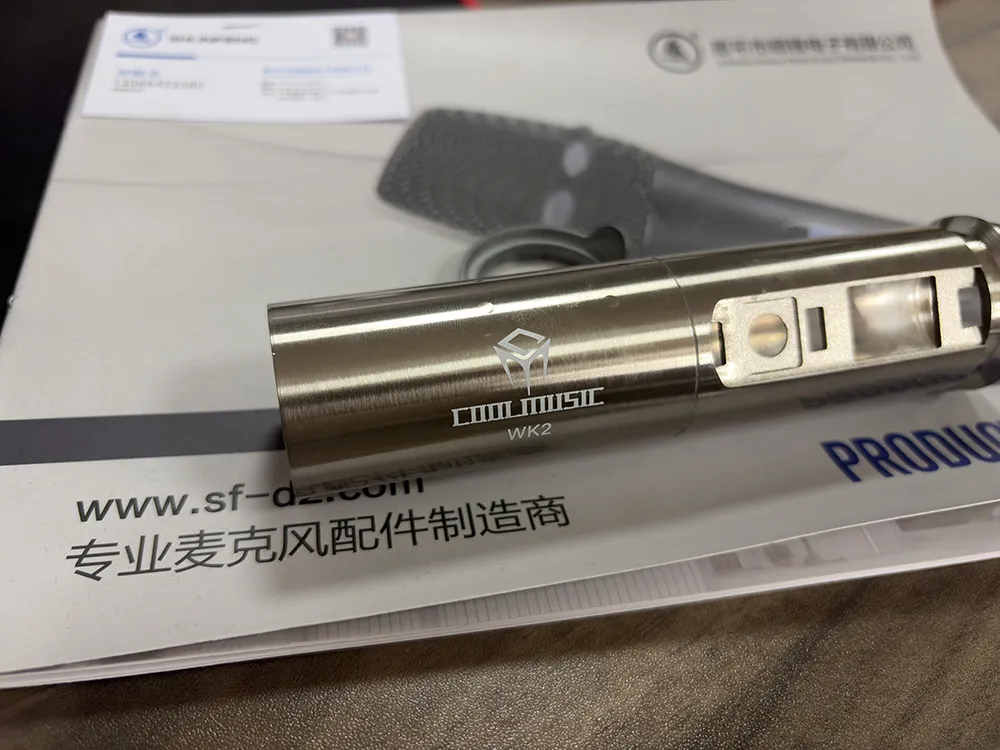
Why Silk-Screen Printing on Microphone Bodies Is More Complex Than Flat Surface Printing
Many customers tend to evaluate silk-screen printing on microphone housings based on their experience with flat products, which often leads them to underestimate the difficulty. A microphone body is a cylindrical curved surface, and its surface is usually treated with spray painting, electroplating, anodizing, or other finishes. These two factors give the silk-screen printing process its own specific requirements.
More specifically, the main challenges include:
- Curved surface positioning accuracy: The diameter of a microphone body is usually between 22 mm and 35 mm. During silk-screen printing, a dedicated roll-printing fixture is required, and the logo position tolerance must be controlled within ±0.3 mm. Otherwise, visible misalignment may occur across mass-produced units.
- Compatibility with surface treatment layers: Baked paint, UV coating, and electroplated surfaces all show completely different ink adhesion performance. A single ink solution cannot be used for all surface types.
- Wear-resistance requirements for handheld products: Microphones are frequently exposed to hand sweat, cosmetics, and alcohol-based disinfectants. As a result, the logo requires much higher chemical resistance than ordinary consumer electronics housings.
Five Key Process Steps for Customizing Logos on Microphone Bodies
1. Pretreatment: The First Step That Determines Adhesion
In failed silk-screen printing cases, more than half of the problems are caused by inadequate pretreatment. Different surfaces require different treatment methods:
- Painted microphone bodies: After the paint surface is cured, it should be left to stand for at least 24 hours before silk-screen printing. If printing is carried out before the paint is fully cross-linked, the logo may peel off together with the paint layer later.
- Electroplated microphone bodies, such as chrome-plated or nickel-plated surfaces: These surfaces have low surface energy, so flame treatment or plasma treatment is required to improve adhesion. If printed directly, the pass rate for adhesion testing is usually very low.
- Anodized aluminum bodies: The sealing process affects ink penetration. It is recommended to confirm the silk-screen printing solution before sealing, or use special ink designed for anodized surfaces.
2. Ink Selection
The core principle of ink selection is to ensure compatibility among the substrate, the ink, and the actual usage environment.
- For electroplated metal surfaces, two-component inks are preferred. After curing, they form a higher cross-linking density and provide more stable resistance to alcohol wiping.
- When a metallic logo effect is required, such as silver or gold, attention should be paid to the balance between the covering power of the metallic pigment ink and the mesh count of the screen. If the mesh count is too high, metallic particles may be filtered out, causing the printed logo to appear dull or gray.
- For products exported to Europe and the United States, it is necessary to confirm in advance that the ink complies with RoHS and REACH requirements. This should be clearly written into the purchasing specification, rather than being tested only after production.
3. Screen and Artwork Design: Details Determine Yield Rate
When brand owners provide logo files, the following points directly affect the printing yield:
- The minimum line width is recommended to be no less than 0.15 mm. If the line width is below this value, broken lines or screen clogging may easily occur during curved-surface roll printing.
- Avoid printing large solid color blocks and fine lines on the same screen. These two types of graphics require different ink volumes and squeegee pressures, making it difficult to balance them in one printing pass.
- Use gradient effects with caution. Gradients in silk-screen printing rely on halftone dots, and the effect is limited on small-size logos. If the brand VI includes gradient elements, pad printing or laser engraving can be considered as alternative solutions.
- Provide vector files, such as AI or EPS formats. Converting from bitmap images may reduce edge accuracy.
4. Curing Process: The Final Safeguard for Adhesion
- The tunnel oven temperature and curing time for solvent-based inks should be adjusted according to the material of the tube body. Zinc alloy tubes conduct heat quickly, so their curing parameters differ from those used for aluminum tubes.
- When curing UV inks, different positions on a curved surface receive uneven UV energy. A rotary curing device is required to ensure consistent curing on both sides of the logo.
- An insufficiently cured logo may pass outgoing inspection, but after 2–3 months of use by the customer, whitening or peeling may occur. Such issues can be very costly to trace and resolve.
5. Inspection Standards: Both Parties Should Align in Advance
It is recommended to confirm the following inspection items and standards with the factory during the sampling stage:
- Cross-cut test (adhesion): GB/T 9286 or ASTM D3359, generally requiring a result of 4B or above.
- Alcohol abrasion resistance test: 500 g load, 95% alcohol, with no obvious color fading after more than 100 back-and-forth cycles.
- RCA abrasion test: Suitable for stage microphones with higher wear-resistance requirements.
- Color difference standard: The ΔE value should be clearly defined in the contract or specification sheet, especially for brand standard colors.
Questions Brand Owners Should Confirm with the Factory Before Placing an Order
Based on our experience working with global customers, clarifying the following points before placing an order can help avoid most mass-production issues:
- What is the surface treatment method for the microphone tube? Is the silk-screen printing done before or after the surface treatment?
- Does the logo have a specified Pantone color code? Is a certain range of color variation acceptable?
- What abrasion-resistance level is required for the intended application scenario, such as stage, KTV, or conference use?
- Is a protective clear coating required after silk-screen printing?
- How many samples will be made, and what is the sample approval process?
Beyond Silk-Screen Printing: When to Consider Other Logo Processes
Silk-screen printing is not the only option. Objectively, it has its own application limits:
- Laser engraving: Suitable for anodized aluminum tubes. The logo is permanent and will not peel off, but it can only present a single color by exposing the base material color.
- Pad printing: Suitable for smaller logos or patterns on more complex curved surfaces.
- Hot stamping / heat transfer printing: Suitable for high-end product lines that require a glossy metallic effect, but cost and wear resistance need to be carefully balanced.
If your product is positioned for high-frequency stage use, a combined solution of laser engraving plus silk-screen printing is often more reliable in terms of durability than silk-screen printing alone.
How Long Can a Silk-Screen Printed Logo Last Without Peeling Off?
If the surface pretreatment, ink selection, and curing process are all properly controlled, a silk-screen printed logo that passes the 4B cross-cut adhesion test and the 100-cycle alcohol abrasion test can generally remain free from obvious wear for 3–5 years under normal use.
For high-intensity stage applications, it is recommended to add a protective clear coating after printing or switch to laser engraving for better durability.
Can a Multi-Color Logo Be Silk-Screen Printed?
Yes. Multi-color logos can be achieved through multiple rounds of registration printing.
However, registration on a curved tube surface is more difficult than on a flat surface. With each additional color, the production yield may decrease and the cost will increase accordingly.
For microphone tube printing, we generally recommend using a simplified version of the brand logo with no more than two colors.
How Long Does Sampling and Mass Production Usually Take?
Silk-screen logo sampling usually takes about 5–7 working days, including screen plate making.
After the sample is approved, the mass production lead time depends on the order quantity. For regular orders, the typical production cycle is around 25–30 days.
For first-time cooperation, it is recommended to reserve enough time for sample review and confirmation before moving into bulk production.
What Logo File Format Should the Customer Provide?
Vector formats (AI, EPS, PDF) are preferred. Please also indicate the Pantone color code and provide a placement/size drawing showing the logo position on the tube body.
If only a bitmap file is available, the resolution should be 600 dpi or higher, and some loss of edge precision should be expected.